Revolutionising Stroke Rehabilitation with Design and Robotics
Using rehabilitative robotics, BioLiberty, a health tech startup, aims to bridge the gap between hand weakness and independent living for stroke patients. Working with their hardware team, I facilitated a design sprint focused on creating a clinician-led tablet application and portal for stroke patients, addressing acute inpatient care settings in the US market.
The Problem
In the US, over 800,000 strokes occur annually, with 88% of survivors experiencing upper limb weakness. By 2030, the demand for Occupational Therapy (OT) services will surpass the supply across all 50 states.
BioLiberty aims to address this shortage through technology that enhances clinician productivity, streamlines workflows, and improves patient outcomes. The challenge was designing an accessible and usable platform that seamlessly integrates into clinical processes while empowering both clinicians and patients.
Scope Evolution
BioLiberty had previously worked with Big Motive on software iterations designed for home use. However, the project scope evolved to focus on acute patient care within hospital settings across the US healthcare landscape. This pivot required rapid iteration of the user experience to align with the new deployment context.
The Approach
I facilitated an intensive design sprint to enable rapid prototyping and testing of the clinician platform. The sprint focused on three key objectives:
Data Visualization
Determining what data is important for stroke patients going through rehabilitation and occupational therapists, then visualizing it in a user-friendly interface that keeps patients engaged and motivated while helping clinicians make informed decisions.
User Interface Design
Redesigning the platform to align with the updated scope for deployment of Lifeglov in an inpatient setting for the US market, ensuring it fits seamlessly into clinical workflows.
Clinical Validation
Testing with real users to validate assumptions and iterate based on clinician feedback from actual hospital settings.
Clinical Research
To validate our designs, I worked with BioLiberty to conduct interviews with our target user group of clinicians in 5 different hospitals across the US:
- California Rehabilitation Institute
- Texas Rehabilitation Hospital of Fort Worth
- Saint Francis Hospital
- Sai Rehab
- Mount Sinai Hospital
These sessions provided invaluable insights into clinical workflows, data needs, and integration requirements.
The Solution
Through the design sprint, we developed a validated prototype consisting of two interconnected platforms:
Clinician-Led Tablet Application
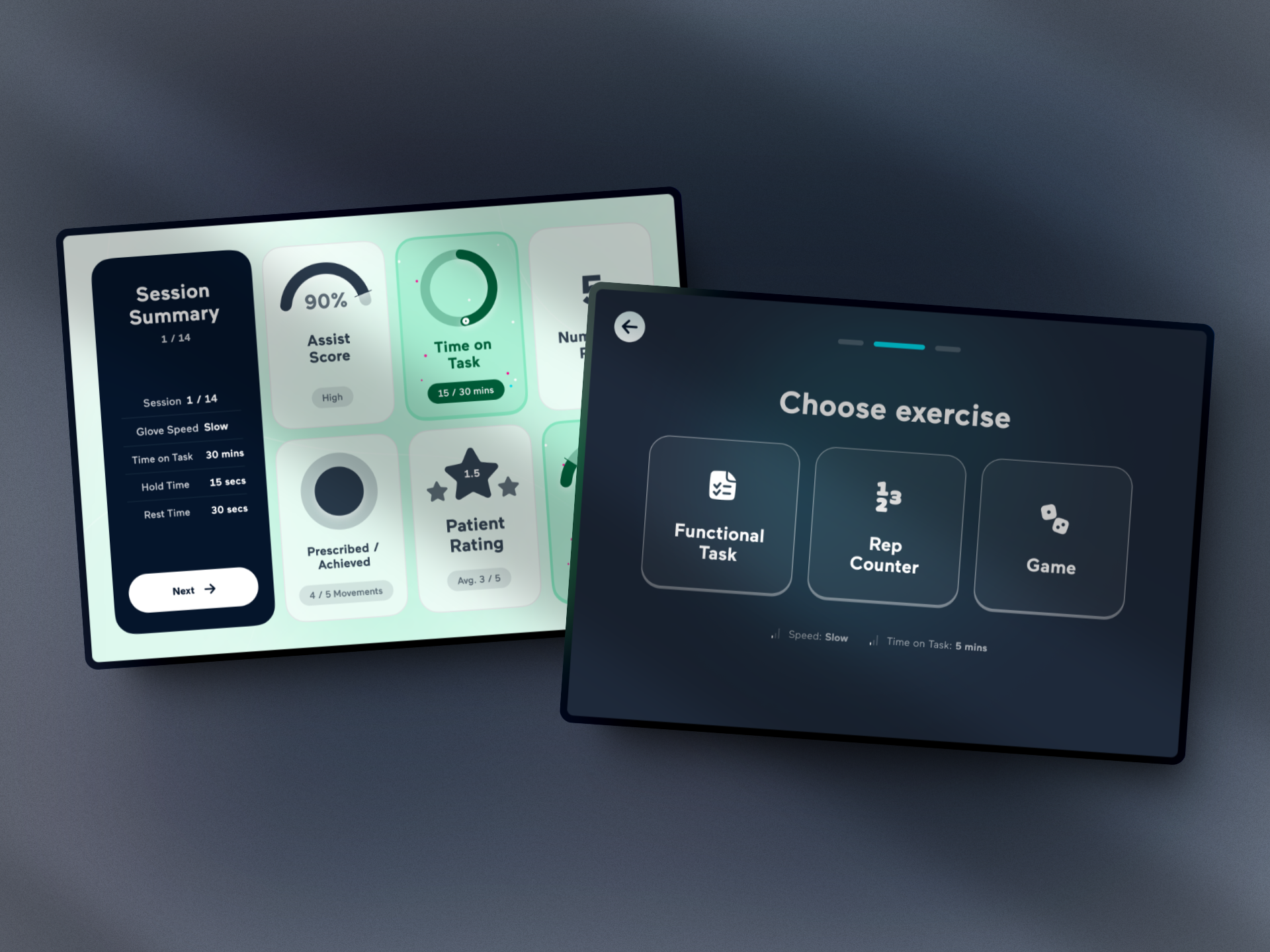
A tablet interface that occupational therapists use alongside the Lifeglov device during patient sessions, providing real-time feedback, exercise guidance, and progress tracking.
Clinician Portal
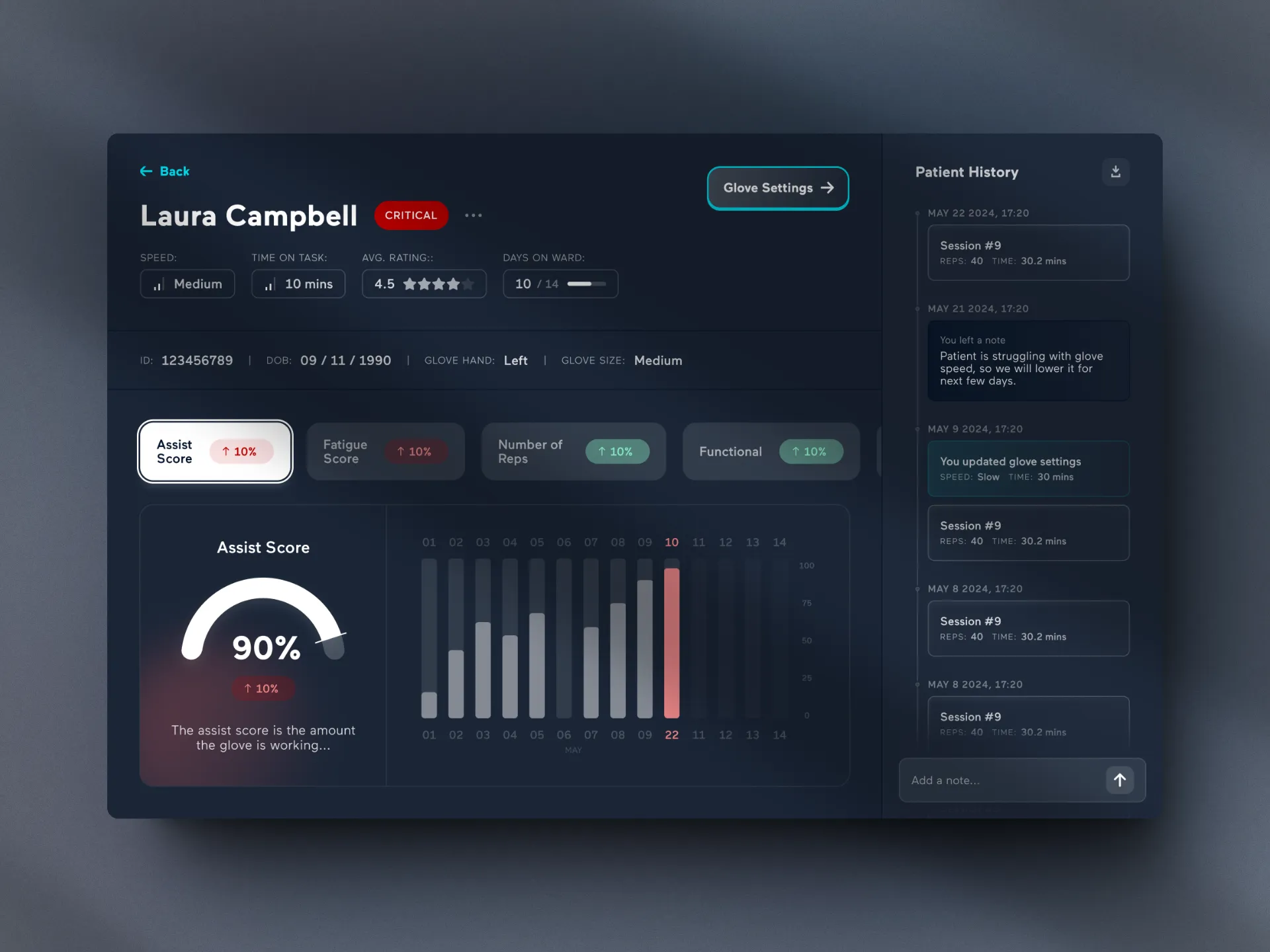
A web-based dashboard that gives healthcare professionals access to patient rehabilitation data, enabling them to monitor progress, adjust treatment plans, and demonstrate outcomes to stakeholders.
Key Focus Areas
Smart Data Visualization We determined which metrics matter most—for patients, it’s about motivation and progress; for clinicians, it’s about outcomes and clinical decision-making. The interface surfaces the right data to the right people at the right time.
Workflow Integration The platform was designed to fit naturally into existing clinical processes, minimizing training time and maximizing adoption among busy healthcare professionals.
Rapid Validation First iteration designs were prototyped and ready for testing in just 2 days, allowing us to quickly gather feedback and iterate.
Impact
In a short period, we swiftly developed a validated prototype for a clinician-led app and portal. This work supports the BioLiberty team in empowering clinicians and stroke patients with valuable rehabilitation data.
The platform addresses the growing demand on occupational therapists and clinicians across the US by:
- Boosting clinician productivity through streamlined workflows
- Providing actionable rehabilitation data
- Improving upper limb outcomes for patients
- Scaling personalized therapy beyond the constraints of therapist availability
BioLiberty offers a glimpse into the future of stroke rehabilitation healthcare—where technology amplifies human expertise rather than replacing it.